
Azrieli Fellowship awarded to Shilo Ohayon
39 new Azrieli Fellows selected for 2018/19 The Azrieli Fellows Program has completed its annual selection process, granting 25 new Fellowships for graduate students in the fields of Sciences, Social sciences, Education, Humanities and Architecture & Urban Planning, 6 international postdoctoral Fellowships for research in varied fields and 8 Faculty Fellowships for returning scholars.
Since the Program’s inception in 2007, more than 250 of the best and brightest researchers at universities in Israel have been supported.

Simulation of single-protein nanopore sensing shows feasibility for whole-proteome identification
Our simulations study show feasibility of whole proteome nanopore sensing. Shilo, Arik and Maisa’s paper final version is published in the Open Access journal PloS Computational Biology Congratulations!
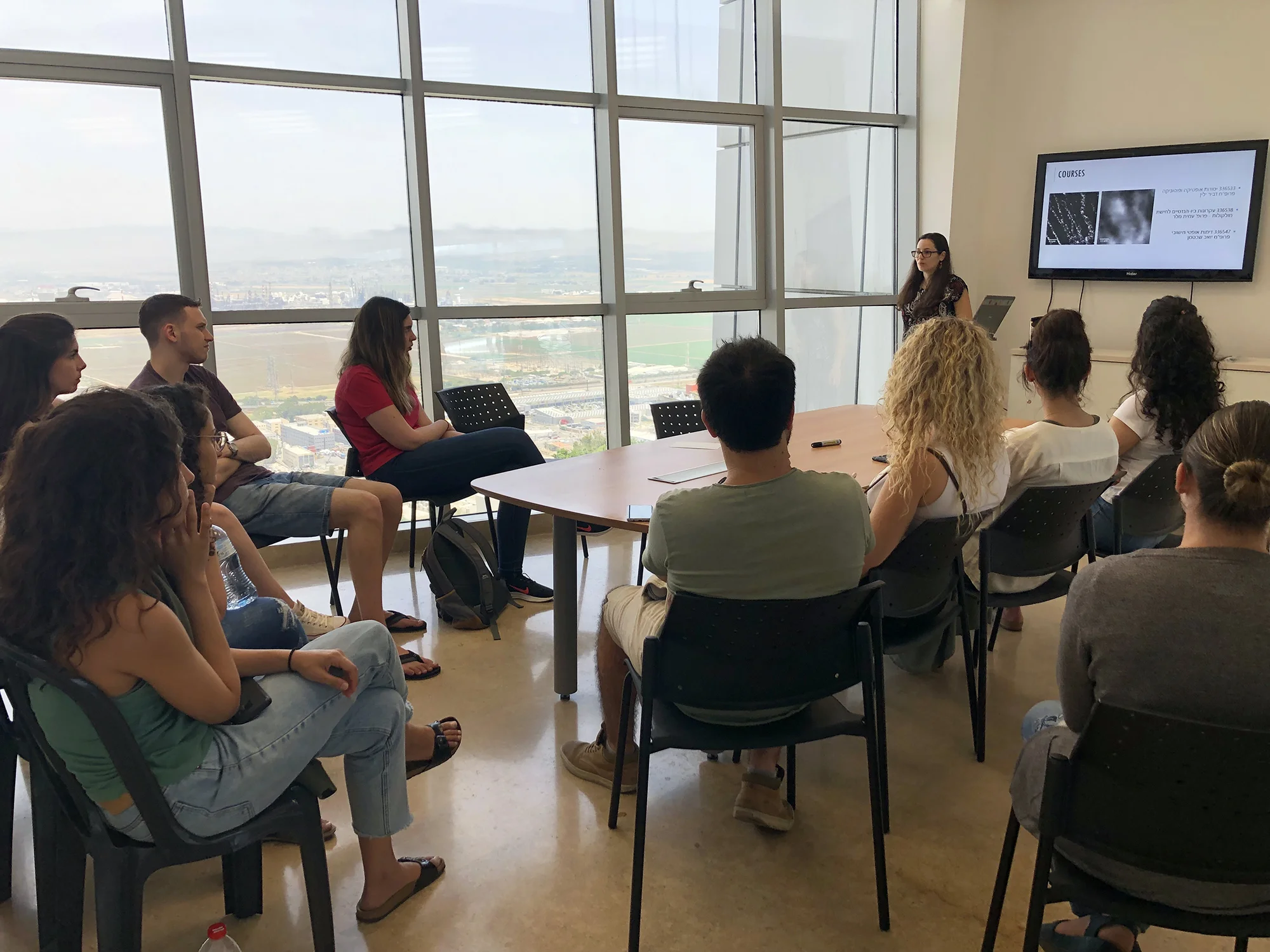
Lab open day - 22.5.19
On May 22, 2019, our lab hosted undergraduate students from the biomedical faculty for a lab open day. The students heard lectures about super-resolution microscopy and single molecule sensing in nanopores. Following the lectures, the students participated in a lab tour covering the main sections of the lab, and were exposed to our interdisciplinary research.

Congratulation to Chen for winning the Jacobs Fellowship!
Chen , A Ph.D. student in our lab, has recently won the prestige Irwin and Joan Jacobs Fellowship. Chen’s Ph.D. research is focusing on single-molecule mapping of DNA epigenetic cancer biomarkers using LNA probes selection and solid-state nanopores. Way to go Chen! Mazal tov! :)

Prof. Meller awarded the ERC Advanced grant
Today ERC announced the winners of the Advanced awards (ERC-ADG). Prof. Meller is among the recipients of this year’s awards for the development of a new method for single-molecule protein identification using solid-state nanopore arrays.

Automated, ultra-fast laser-drilling of nanometer scale pores and nanopore arrays in aqueous solutions
In our recent publication (Advanced Functional Materials ) we show that low-intensity laser etching and nanopore formation in amorphous silicon-nitride (SixN) freestanding films highly depends on the Si to N ratio. Increasing the relative Si content yields orders of magnitude increase in etch rate, which is further accelerated in alkaline environments, enabling the fabrication of nanopore arrays within tens of seconds at any arbitrary location.