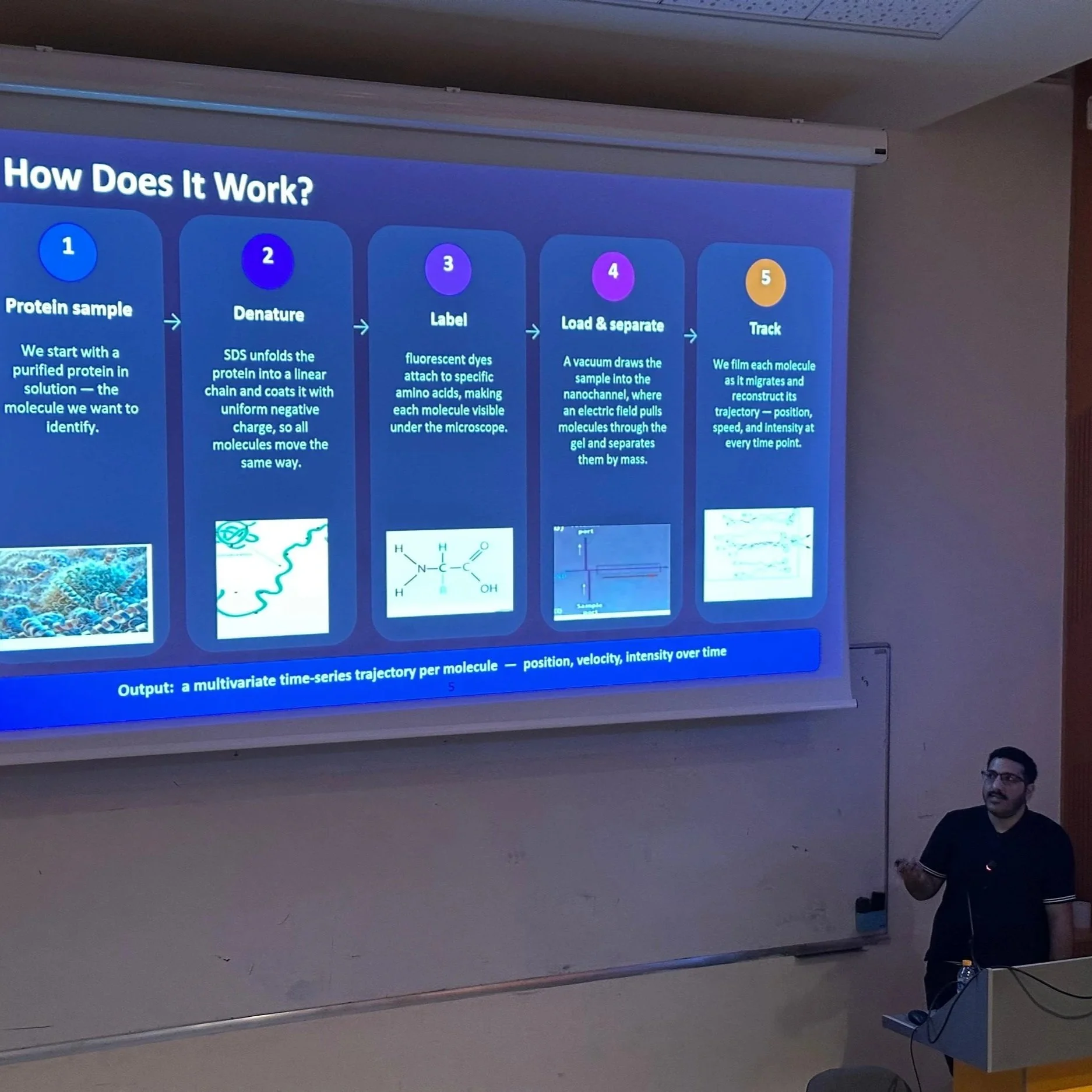
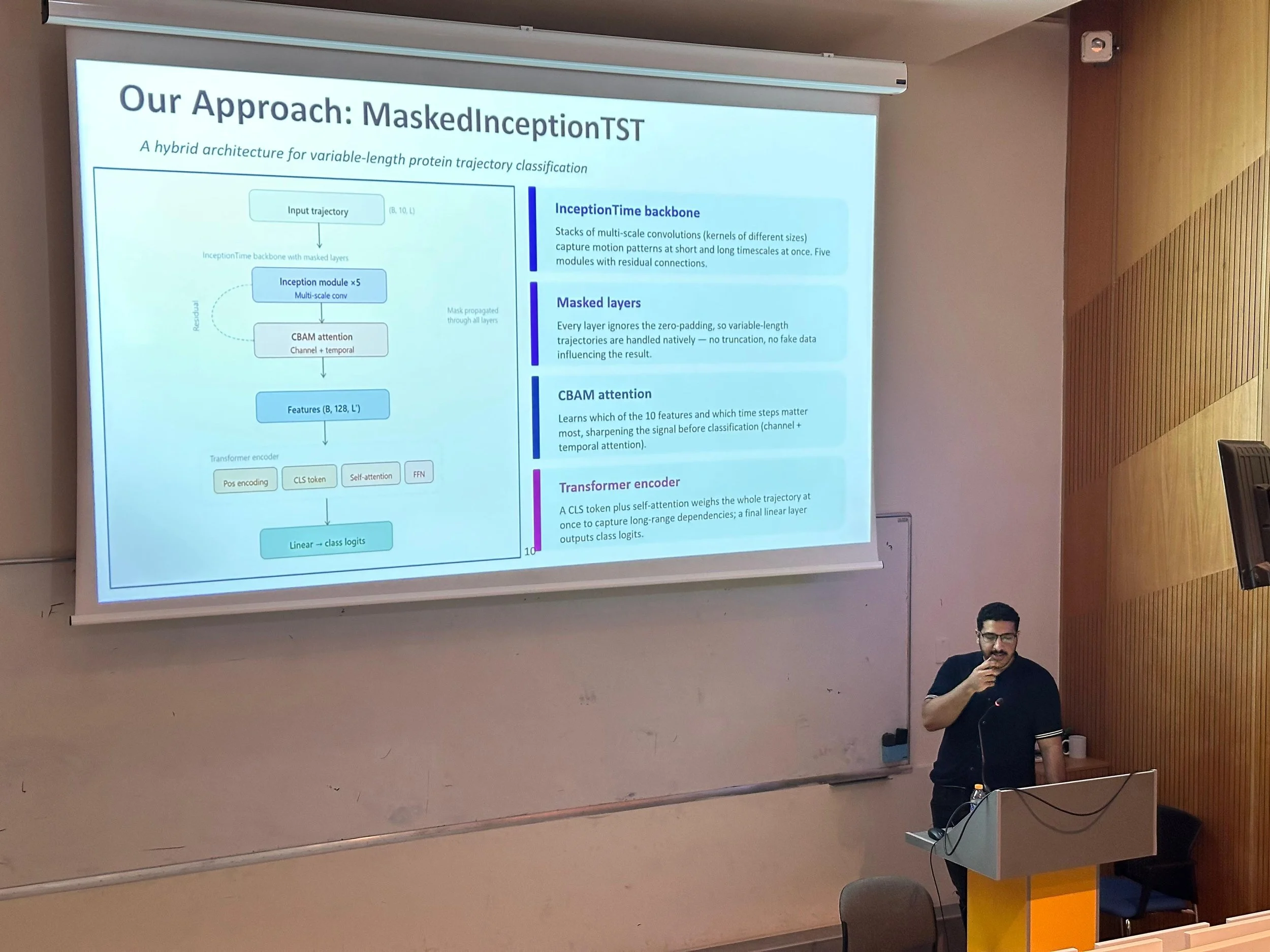
Ali Kaiyal presented his research in a faculty seminar!
In his seminar, Ali, an MSc student, shared his work on deep learning-based classification of single proteins using nanochannel fluorescence sensing data. He presented a novel machine learning framework that analyzes the rich optical and physical trajectories generated as individual proteins pass through a nanochannel, enabling direct protein identification from raw sensing data.
Ali’s approach is built around a custom hybrid neural network architecture, MaskedInceptionTST, designed to handle variable-length sequences, class imbalance, and cross-session generalization. The model also addresses the challenge of identifying previously unseen protein classes by recognizing when an input does not belong to any class encountered during training.
This work lays the foundation for intelligent, data-driven single-molecule protein identification, with strong potential for fast, accurate, and noninvasive sensing platforms for future biomedical applications.
Great work, Ali!

Check our new paper in ACS Nano Journal about amplification-free mitochondrial DNA quantification
In our latest research, we introduce a solid-state nanopore method for label-free, amplification-free detection of mitochondrial DNA (mtDNA), a key biomarker for disease. Using machine learning and exonuclease digestion, we achieve high accuracy in distinguishing mtDNA from genomic DNA in biological samples. This approach offers picomolar sensitivity with minimal preparation, making it ideal for clinical diagnostics.


Noam presented his final PhD seminar entitled "Single-Molecule Protein Sensing for Early AMD Diagnosis”
In his seminar, he talked about the use of single-molecule sensing technology for early detection of age-related macular degeneration (AMD), a leading cause of vision loss in older adults. Unlike traditional methods that detect physical damage, this approach analyzes molecular biomarkers like VEGF and Clusterin with high precision. Single-molecule techniques, such as nanopore-based sensors or dynamic sensing using nanoparticles, allow real-time tracking of individual protein interactions, enabling ultrasensitive detection at subfemtomolar levels. These methods improve diagnostic accuracy by identifying molecular changes before significant vision loss occurs, paving the way for earlier intervention and personalized treatments. This innovation could transform AMD management, reducing its socioeconomic impact and enhancing patient outcomes.


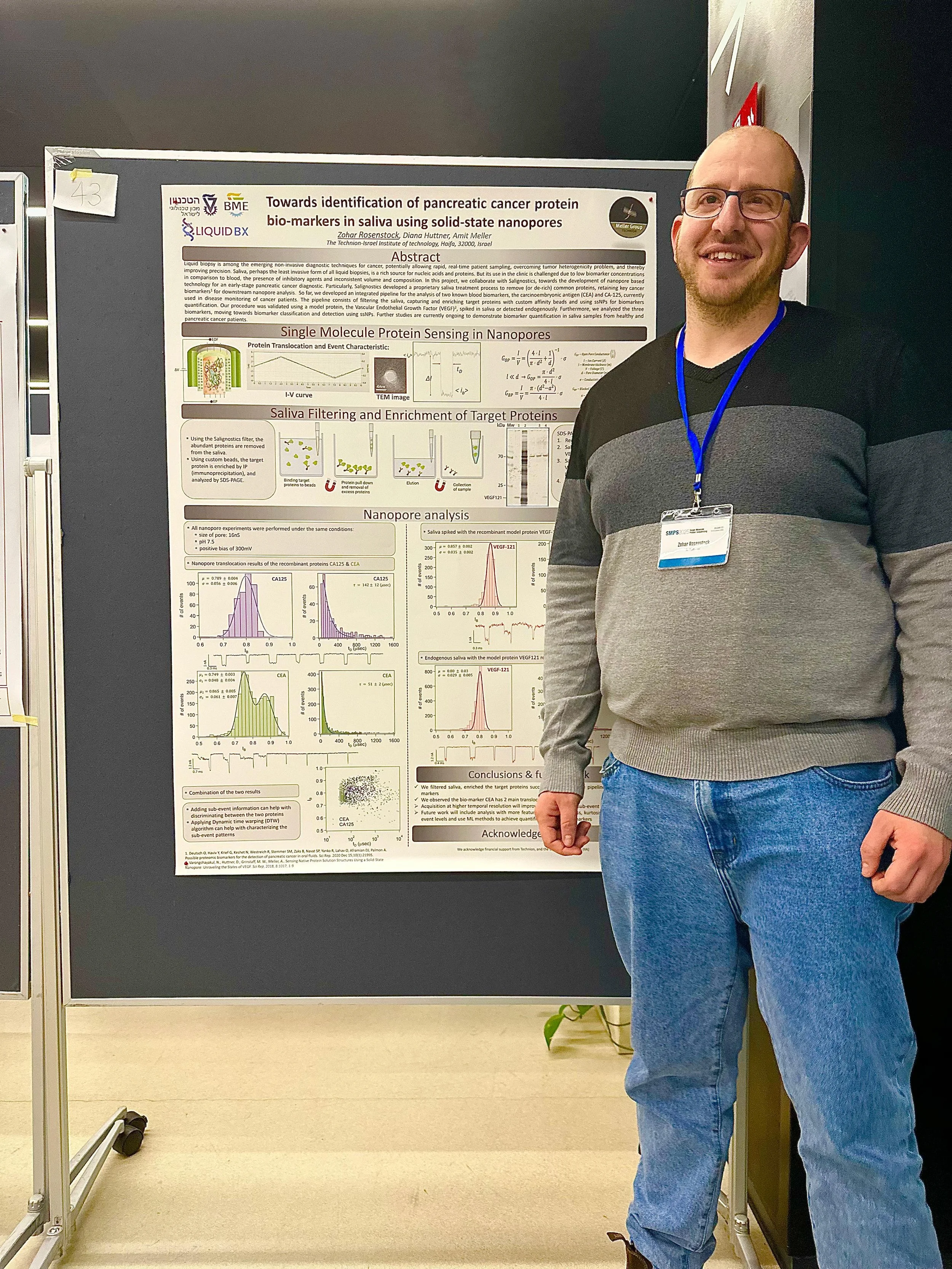
Success at SMPS 2025 Conference in Bolzano, Italy
Part of our lab team: Prof. Meller, Dr. Marzia Issorai, Dr. Navneet Varma, and Zoahr Rosentock participated in the SMPS 2025 Conference in Bolzano, Italy.
The SMPS 2025 Conference brings together leading experts in Soft Matter and Polymers, offering a platform for groundbreaking research and collaboration. Prof. Meller was a featured speaker, giving a lecture on our lab's SMPS research.
Congratulations to Dr. Marzia on winning the First Poster Prize. This remarkable achievement highlights our lab's innovative research.
You can learn more about the conference here.




Welcome to Meller lab, Ali Kayyal!
Ali Kayyal, new MSc student joined our Lab.
Ali’s research will focus on developing an innovative deep-learning approach for protein classification, using data derived from protein sensing and tracking experiments. This work aims to improve classification accuracy and reveal subtle patterns within protein structures and dynamics, advancing proteomic analysis.
Welcome to our team Ali and best of luck!


Celebrating Rosh Hashanah in Meller lab
As we welcome the Jewish New Year, Rosh Hashanah, our lab takes a moment to reflect on the past year and embrace the opportunities ahead.
We raised a toast to celebrate the new year together.
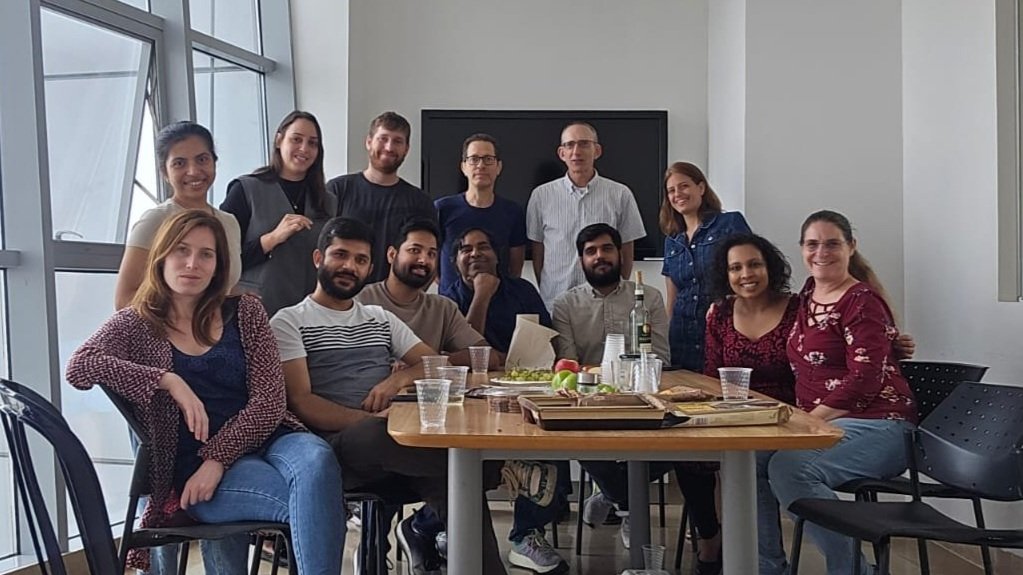
we wish you a sweet and fulfilling new year! Shana Tova!