
Shilo Ohayon presents a talk at the: HealthIL - BME Satellite Event: Engineering the Future of Healthcare
Shilo Ohayon presented the lab research and advancement in single-molecule protein identification and quantification technologies. The 10 min talk was aimed at the general audience and reviewed the latest developments in single-molecule sensing, optical sensing using nanotechnologies such as nanopores and submicron channels.
The talk briefly explained the foundations these technologies are based upon and the importance of this technology have on digital health.
In the future, we believe our technology could assist fast and accurate diagnostic in the community and better monitoring of patients.
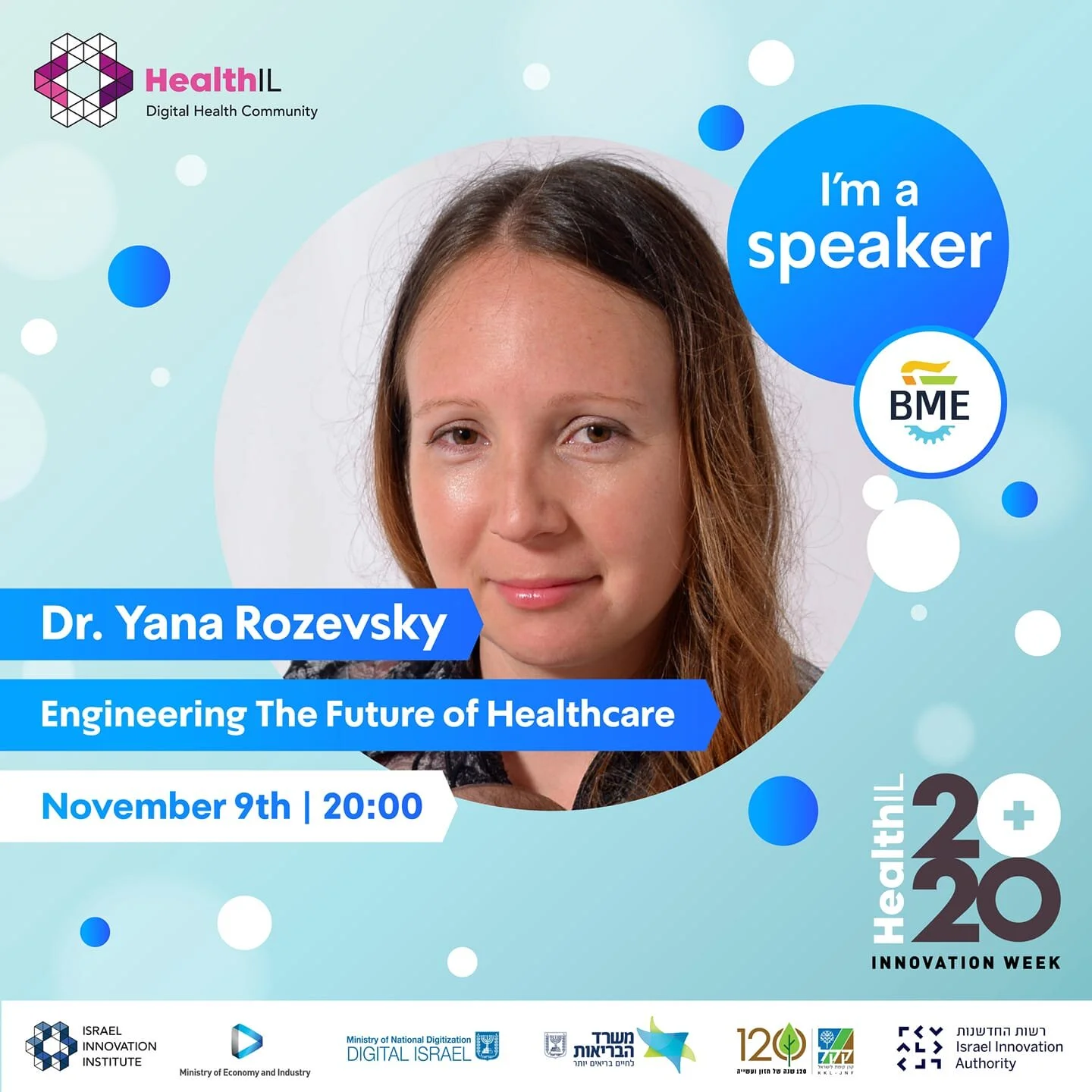
Yana Rozevsky presents a talk at the: HealthIL - BME Satellite Event: Engineering the Future of Healthcare
Dr. yana Rozevsky a postdoc fellow in our group presented a talk at HealthIL - BME Satellite Event: Engineering the Future of Healthcare, entitled: An RNA based technology for digital patient diagnosis. She described our nanopore-based technology developed for detecting RNA viral loads and cancer load in vitro and clinical samples. Our results have recently been published in ACS Nano (https://doi.org/10.1021/acsnano.0c06375). We demonstrated the sensitivity and feasibility of our technique to detect low levels of RNA, beyond the current gold-standard approach, RT-qPCR. We showed accordance between our nanopore-based approach to RT-qPCR result in one clinical sample as an example. We currently focusing on developing a full hands-free lab-on-chip device for single RNA molecule analysis. In the future, we hope that this technology can provide broadly accessed diagnostic devices for digital health use at the point of care. Specifically, we hope that it will be used to combat the coronavirus pandemic and other RNA based viruses by providing early and accurate on-site sensing of the pathogens’ RNA.


Our work on nanopore sensing of ITP-focused analytes is out now in Nanoscale
Microfluidic device for coupling isotachophoretic sample focusing with nanopore single-molecule sensing
Nanopore sensing remains challenging at low target concentrations, where the detection rate is limited by slow diffusion of analytes into the sensing volume. In this work, we show that an electrokinetic preconcentration method called isotachophoresis (ITP) can be used to deliver a highly concentrated zone of analytes to a solid-state nanopore. The key to ITP-nanopore sensing lies in the ability to electrically decouple the two modes to avoid damaging the fragile dielectric membrane. By choosing electrolyte conditions that enable both efficient focusing and sensing, and by implementing electrical switching in a custom microfluidic device, we show that ITP focusing can enhance the event rate by over 300 times compared to free diffusion.

Welcoming Neeraj at Hunta bar
Celebrating our new student Neeraj joining the lab at the “Hunta pub” Technion

Karawan Halabi and Noam Freundlich Welcome to the Lab!
Karawan and Noam are new MSc students in our lab. Both completed their degree in Biomedical Engineering this year. Karawan and Noam will be joining our protein identification team.

Read Amit's N&V article in Nature Nanotechnology
Scanning Nanopore Microscopy - A new tool for cell signalling research
The combination of a nanopore and an atomic force microscope allows stochastic sensing of secreted molecules and the activity of ion channels in arbitrary locations both inside and outside of a cell. In this News & Views article I highlight recent paper by Aramesh and colleagues in Nature Nanotechnology.